THE ENFORCEMENT
PROBLEM
THIRD EDITION OF THE ENFORCEMENT PROBLEM
No improvement: Enforcement remains low and inconsistent - the legal framework protecting farmed animals is being eroded.
UNMASKING THE REALITY ON BRITISH FARMS
The UK proudly wears the badge of being a nation of animal lovers, championing some of the world's highest animal protection standards. However, our data from our third edition of The Enforcement Problem reveals a much less flattering picture for farmed animals in the UK. You can read the full report here

THE ENFORCEMENT PROBLEM
What is The Enforcement Problem?
The United Kingdom is often said to have some of the best animal welfare laws in the world. Sadly, these statements fail to consider the daily reality for the majority of farmed animals in the UK.
Three years ago, we began asking a fundamental question: Is the system designed to protect farmed animals actually working?
For the third time in December 2025, The Animal Law Foundation gathered and analysed enforcement data across the United Kingdom. The data shows widespread and systemic under-enforcement of the legal frameworks intended to offer protection for farmed animals.
Our third report analyses data from across the UK in 2024 to assess how effectively animal welfare laws are being enforced in practice and whether progress has been made. Sadly our third analysis reveals little improvement from our previous two reports – one published in 2022 in partnership with Animal Equality, covering data from 2018 to 2021, and the other published in 2024, covering data for 2022 and 2023.
Key takeaways from 2024:
Only 2.2% of farms were inspected across the UK
Of those inspected 28.4% revealed non-compliance with welfare law
Only 2.2% of cases of non-compliance on farms resulted in prosecutions
Only half of all complaints about farm animal welfare in the UK resulted in an inspection
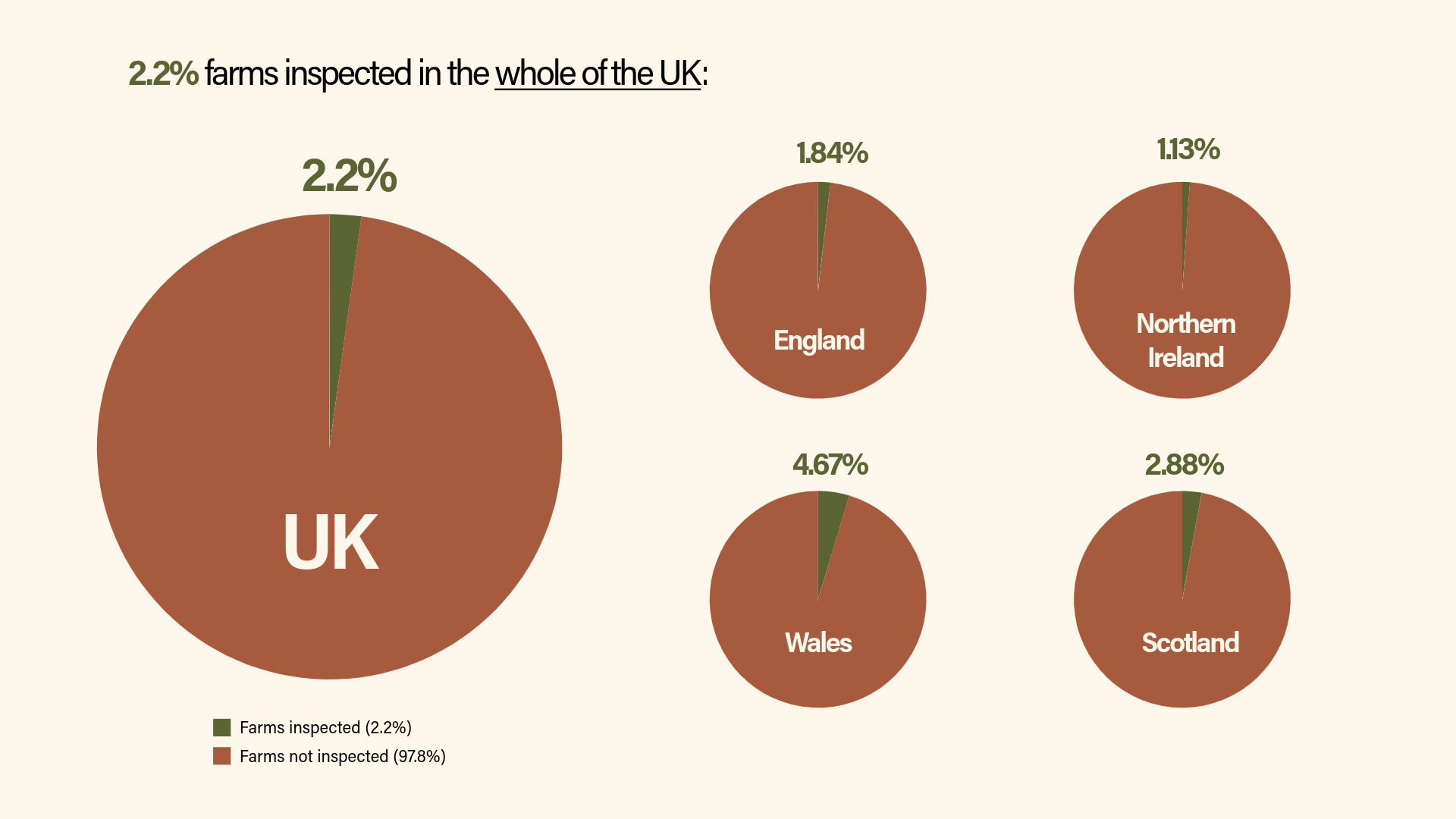
Across all enforcement bodies, only 2.2% of farms were inspected at least once, this is a marginal decrease from 2.53% of farms in 2023.
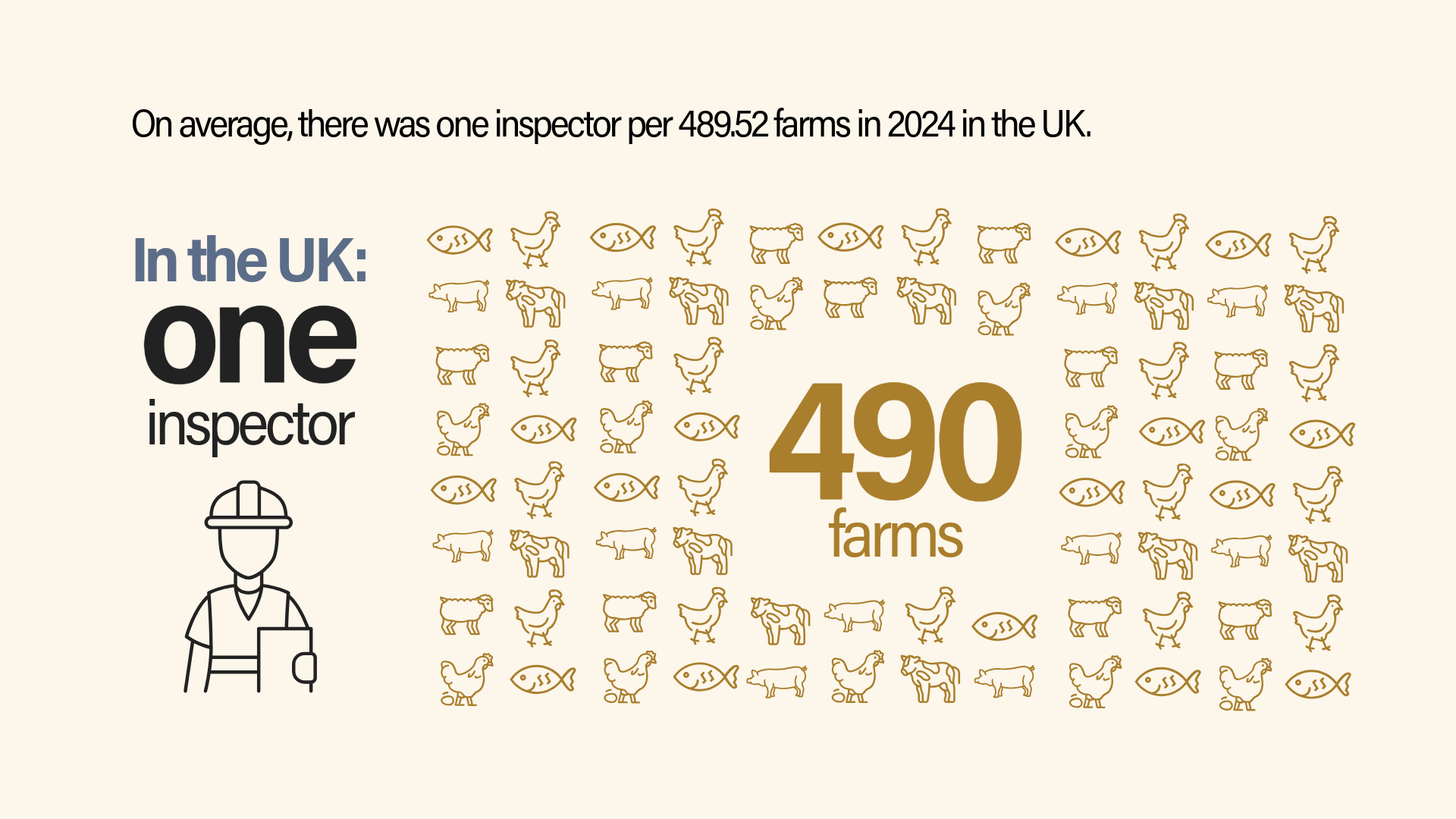
Our data shows a ratio of one local authority inspector for every 490 farms in 2024.
A Call for Accountability
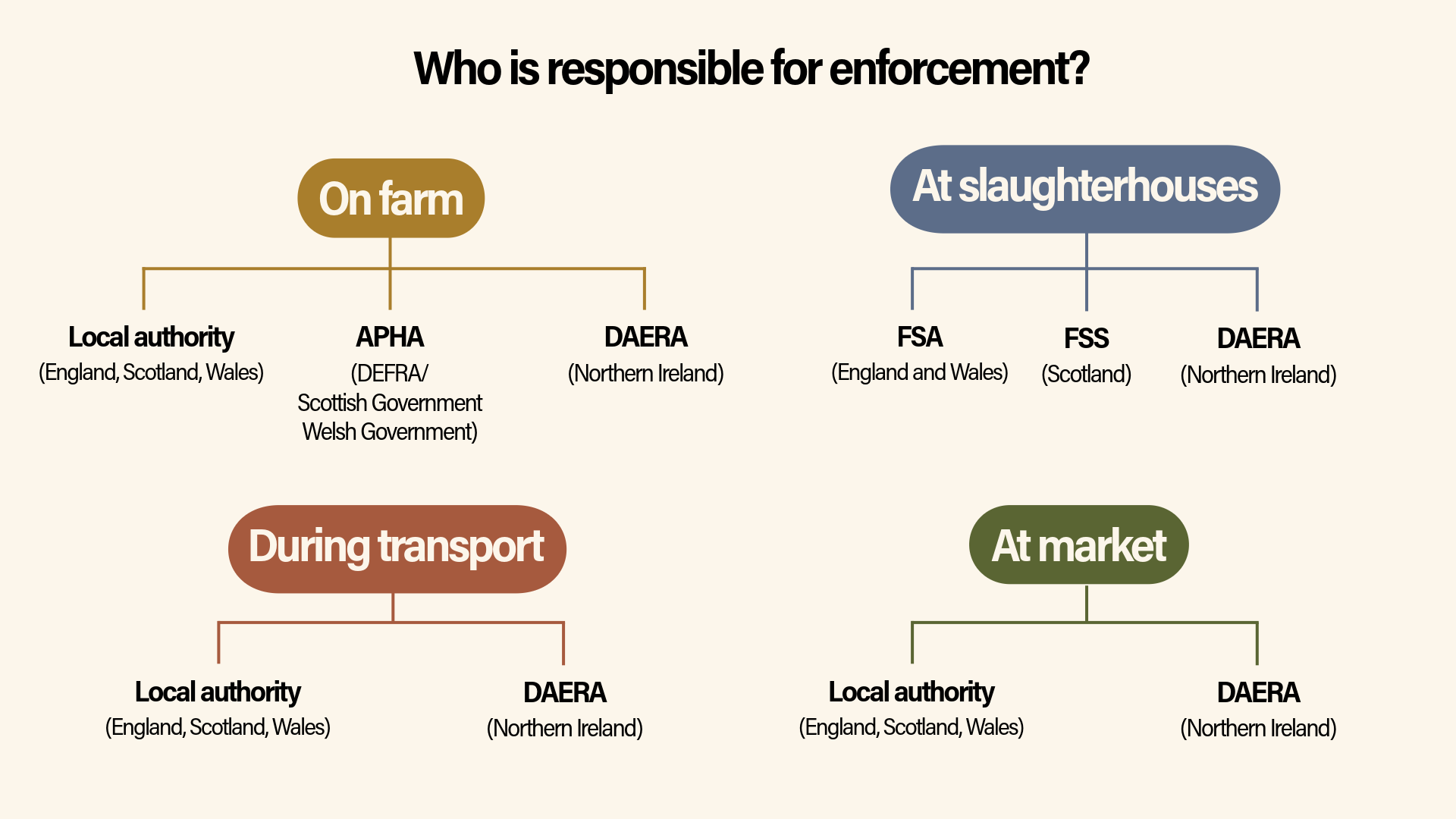
There are several bodies that enforce animal law creating confusion and diffusion of responsibility.
Who is responsible for enforcement?
The regulatory framework for animal welfare is fragmented, with monitoring and enforcement responsibility split between various public bodies. Animal welfare is also a devolved matter, so each country in the UK will have different regulators and enforcement bodies. The Department of Environment, Food and Rural Affairs (DEFRA), the Scottish Government, the Welsh Government, and the Department of Agriculture, Environment and Rural Affairs (DAERA) have overall responsibility for farmed animal welfare law and policy in England, Scotland, Wales, and Northern Ireland, respectively. In practice, with the exception of DAERA, they delegate day to day enforcement of the law to local authorities and executive agencies.
We are calling on the government to Put Animals Back into the Animal Welfare Act and Animal Health and Welfare (Scotland) Act
Weak interpretation and poor enforcement of these Acts has caused the law to shift away from its core purpose, bending too often to commercial interests rather than safeguarding animals.
Growing momentum on the lack of enforcement
The Animal Sentience Committee, a body that considers government policy decisions, published an independent report on the due regard paid to the welfare of animals in the implementation and enforcement of UK laws and regulations protecting animals. The report’s findings echo The Enforcement Problem report’s conclusions; that enforcement is overwhelmingly lacking.
The ASC’s report cited our work and also concludes that “the issues surrounding animal welfare compliance and enforcement relate to inconsistencies in detection of offences, complexity of the legislative environment, resources, lack of coordinated inter-agency response, variable enforcer training and expertise, and transparency over the effectiveness of adequate reporting and enforcement.”
In May 2025, the Chartered Trading Standards Institute published a report, titled (Tackling) Animal Harm. This report highlighted barriers to effective enforcement including legislative gaps, deficits in funding, and the high time and monetary costs of court processes. CTSI found that 84% of local authorities surveyed consider cost to be a barrier to taking enforcement action.
As we discuss in The Enforcement Problem report, local authorities are the main enforcement bodies for farmed animal welfare in England, Scotland, and Wales and are therefore crucial in ensuring animals are protected as set out by UK law. Ensuring that local authorities are adequately resourced is essential for them to effectively fulfil their legal obligations and prevent avoidable suffering.
In June 2025, we presented our findings in Parliament at an All-Party Parliamentary Group for Animal Welfare roundtable discussion on enforcement. We highlighted the alarmingly low rates of inspections and high number of cases revealing illegal activity or prolonged suffering (70%) – yet almost none facing prosecution.
With over 1.2 billion farmed animals and inspections on fewer than 2.5% of farms, we emphasised that the UK’s animal welfare enforcement system is failing animals.

In July 2025, the House of Lords issued a scrutiny report on the Welfare of Animals (Transport) (Amendment) Regulations 2025, in which they raised serious concerns about widespread non-compliance in the chicken industry, limited enforcement of existing welfare rules and lack of clarity on how future compliance will be ensured.
In December 2025, with its Animal Welfare Strategy for England the government committed to strengthening enforcement mechanisms for animal protection laws. It plans to do so by tracking and reporting enforcement actions taken in response to non-compliance - publishing its first data in 2027, and undertaking a review of the enforcement system.
To find out more about The Enforcement Problem, read the full report here.
You can engage with your local Member of Parliament, urging them to commit to ensure the better enforcement of the laws that are in place to protect farmed animals. You can download the letter that you can either post or email to your MP.
TAKE ACTION NOW
DONATE TO HELP ANIMALS TODAY
Millions of animals across the UK suffer every day. With your help, we aim to ease this suffering by enforcing the laws that exist for their protection.